
Robert Arbib's The Lord's Woods: The Passing of an American Woodland
This book begins with as defiant a foreword as I can remember, with allusion to Frost: “Whose woods these are I do not know. I have never seen the man or heard his name. But whoever he may be, he is my mortal enemy” (11). Arbib acknowledges that he is the trespasser, but asserts these woods are “Mine by right of thirty-year intimacy and half a lifetime of communion. Only for me and a few others in these times do these woods exist in all their myriad realities and illusions, their lights and shadows, their music and their silences. They are my woods because I am their witness, their guardian, their penitent, and their lover” (12). These words (one hears echoes of “woods”) may seem hyperbolic, but the pages bear out this intensity of feeling.
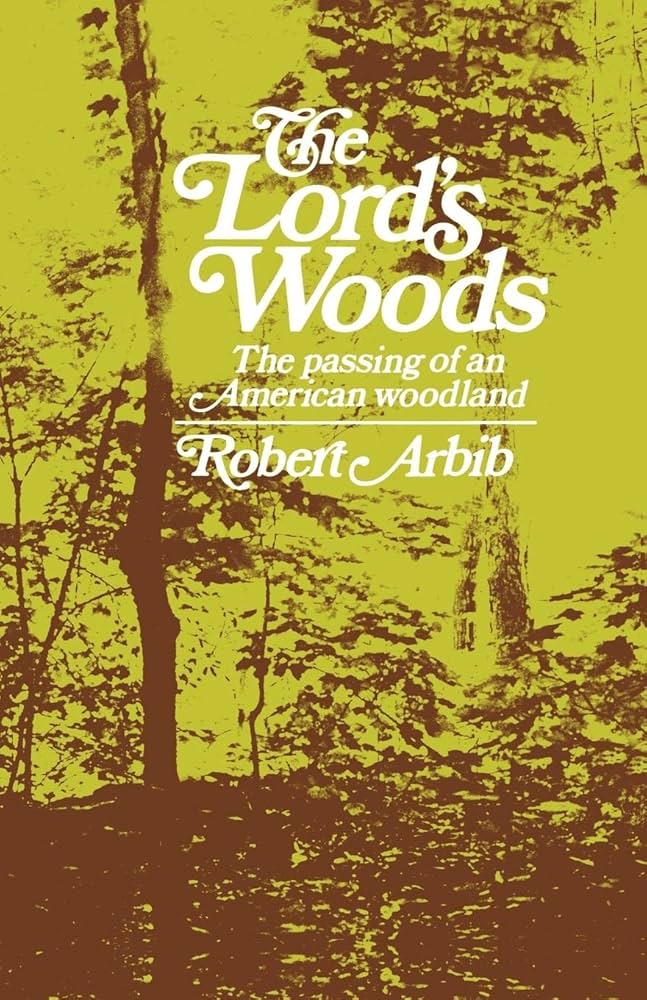
Arbib’s woods are on Long Island in his childhood home of Woodmere. Or were, for as he writes in the foreword, this is not a memoir but a “personal memorial.” They’re called the Lord’s Woods because they once were part of the old Lord Estate. Arbib ventures into them at nine years old with his friend Carl (both of them working on their “natural history museums” in their attic spaces) and in essence he never leaves, not psychologically. Though just at the end of a neighborhood lane, these woods become the boys’ exotic “America” to discover and “own,” language that now has a problematic colonial ring to it, but captures the time and the sensibilities of boys who are fed and play at myths and normative masculinity. But mainly the place is enchanting, for example: “Ferns everywhere around us now, shoulder high, in pale green waves. When Carl walked through the ferns beside the road, it was a disembodied boy’s head bouncing along the top of green surf. The ferns smelled strong, like our oriental brass water pitcher at home. Brassy, not green.” (20-21).
Gradually Arbib explores these woods and the marsh beside them. “We have no words for it, Carl and I, but in our hearts we know that it is beautiful, and everlasting, and precious. This is the first of our discoveries” (36). But these lands are owned by the water company and have a loud pump house at their center with a railroad leading to it to deliver the coal. It's these waterworks that enable the suburbs that will eventually swallow the woods whole. Meanwhile, up against the woods live the poorest families who don’t seem to appreciate the woods quite like middle-class Robert does—he does a nice job drawing out the multiple uses and relationships to these woods throughout the book, even within the context of a present-tense, boyish perspective. The narrator quickly develops a stewardship ethic, at least when it comes to the the woods: “My mother could never understand why I would carry a Baby Ruth wrapper all the way home from the woods and then drop it on my bedroom floor” (66).
Carl and the author explore and map the woods but still don’t know them. “Who can say that these woods they call the Lord’s Woods are truly ours until we come to know and make friends with all the inhabitants of these acres: those who live here and those others who come, as we do, to visit” (52). They start with the wildflowers, each of them trying to transplant some of the understory plants, until one day they run into a group of slightly older boys in the woods who incite them to pay more attention to the birds. “Did you even get an Ovenbird?” one asks.
This encounter transforms Arbib’s life. He falls in with this group, who are dubbed “Dave’s boys” after the influential high school teacher who leads and sponsors this birding club. This club stands out as unique, and is something I admire and envy; my own childhood woods experience was comparatively lonely and individualist. Groups like this are lightning in a bottle. They meet weekly in a basement to go over sightings and talk about an assigned ornithological paper. They even start their own ornithological journal, The Heron (I’ve searched for a copy but can’t find one). Arbib takes over as editor, starts a column in a Long Island paper, and it leads him into his career; eventually he became the editor of the Audubon Society's magazine American Birds, a post he held for fourteen years.
The Lord’s Woods is his first narrative work, I think, and it won the John Burroughs Medals for natural history writing. It is indeed a masterclass in bird writing. One of my favorite passages is when Arbib first encounters a great pulse of warblers going north: “The pale sea-green leaves had opened during the week, and the big bunches of blossoms swarmed with insects. But the warblers everywhere. Without the binoculars, you could see leaves trembling and little bird forms, dark against the mist, darting in a dozen places all at once, as if weaving patterns on the webbing of the foliage. But to identify them, you had to find each in the binoculars and bring it down to earth” (104).
But one of the most interesting chapters (at least conceptually), where the book changes register, is “Summer” (he loses uses the seasons as a structure to describe his maturation and changes to the woods), which suddenly describes Arbib’s first love, Anne, in high school. The experience comes over him like a pulse of warblers. They end up driving into the woods, of course, and park under a tree that becomes known as “Anne’s tree” (added to their personal map of place) where they kiss for the first time. It’s a passionate scene that leads to an epiphany that feels embodied even in the rush of the prose: “And it came to me that these two, the girls I had found and woods I loved, were joined together deep inside me, in some remote center of my being that I could sense and feel and that could make me long and ache, but that I could never wholly understand. … That if I lived for another century there would be no more poignant time for me; that the unspoiled woods and the unspoiled girl would together be the story of my youth" (137-38). Earnest, but somehow it works and feels deeply true. His love for these woods, on display in previous chapters, is so sensuous it is sensual.
From this high point things begin to unravel. Arbib discovers surveyors stakes in the woods and pulls them up, which is shades of Ed Abbey in Arches. It doesn’t work; they come back. First powerlines are pulled through the Lord’s Woods, and then a boulevard. Houses begin to fill the acreage. A play-by-play of the battle to save the woods follows and it feels a little long and nitty-gritty, but I understand its role and rightness: As readers we need to hear this full story, to see how tedious and tense and prolonged a battle for even a small place can be. So I like the writerly move even as I grow a little restless, missing the glow of the woodsy descriptions, but appreciating this environmental reporting. The National Audubon Society’s conservation director Richard Pough makes a cameo, as he visits to assess the preservation potential of the woods, but it’s a local woman who is the director of a garden club who doggedly leads the charge–that’s important for us to see, too.
“How do you measure the needs of the small boy collecting tadpoles in a jelly jar against the demands of a metropolitan transit commission?” Arbib ultimately writes. “But he is not just one small boy. He is all of us. … It is we who can lead America out of her long sleeping sickness, the sickness that killed the Lord’s Woods and millions of other precious acres of America needlessly, and into the bright world we know is possible" (217, 219).