
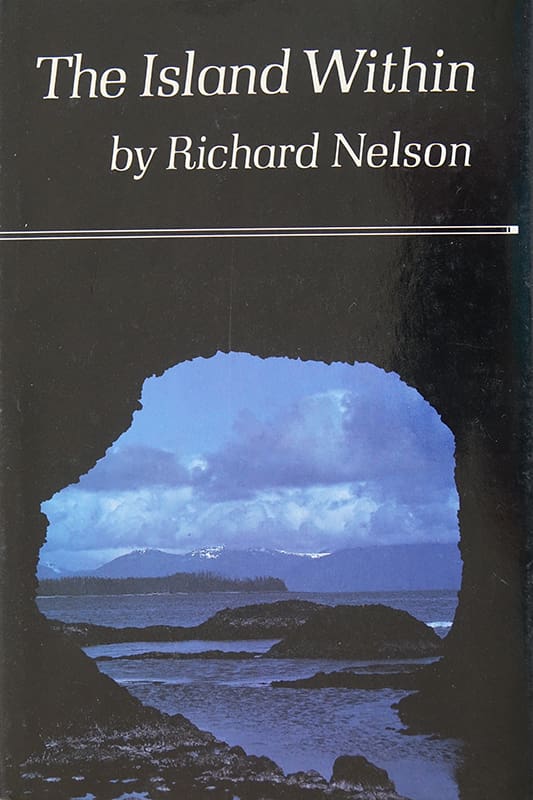
Richard Nelson's The Island Within
My goal in beginning Rural Hours was to also build a hub for conversation about the environmental writing tradition, so at last I’m going to try to honor that intention by starting in on these imagined “rambles.” I think they’ll pretty much resemble a reading log (call it a blog, if you must) as I explore—and, in some cases, finally read for the first time—a few of the books featured on the site. Don’t expect polished or very lyrical prose here, only impressions, a few nuts and bolts (and pressed flowers) tumbled from the drawer of my reading mind. But I do hope to duly honor and draw attention to some amazing books and authors as I (re-)encounter them.
Richard Nelson’s The Island Within (North Point Press, 1989) compels this first attempt, which I guess is a testimony to the book’s power. I absolutely had to write about it! The bookmark laid into my paperback copy reminds me that I bought it 20 years ago, at the age of 20, from the Mono Lake Committee’s great bookstore in Lee Vining, California, when I worked for the Committee as a summer intern. I had heard about the book’s power then, and now I sure regret all the years I let it languish on the proverbial nightstand. What a read, an instant touchstone. I'll be coming back to this one a lot.
Nelson, who died in 2019 (I so wish I had met him--his friends called him "Nels"), was an accomplished anthropologist turned standout ecological writer, if there's a distinction to be made. As he describes midway through The Island Within, he was inspired by the writings of naturalists to pursue biology in college, but “realized I had little affinity for the kind of science I encountered there, with its emphasis on quantified data, controlled experiments, technological monitoring devices, and theoretical analysis.” So he drifted into anthropology “where the descriptive approach had persisted like an orphan child” (161), lived with and studied native peoples in Alaska, and finally came full circle to his literary naturalist inclinations with this deep indigenous perspective in his pocket.
His powers of description pervade The Island Within, which is about his obsession with—his carnal love for—an unnamed island apparently near Sitka. He’s always blasting off across the strait in his skiff to wander the island's beaches and forests. If there’s any critique of the book to be made, it’s that the many descriptive views of shoreline and water sometimes grow a little tiresome (beautiful as they are), but when he arrives at an encounter or an abundance he’s hard to beat. Whales and whale carcasses, brown bears (and their specter), immense schools of herring and salmon. Always his descriptions percolate with useful, surprising imaginative flights. Take for example his foray onto a satellite bird islet, dubbed Kanaashi, which I pluck from the book almost at random as illustration (the chapter reminds of me Dallas Lore Sharp’s visit to a rookery island in Where Rolls the Oregon):
The forest floor is a soft, richly scented loam, permeated with guano and feather and decomposed bird flesh. A handful poured on rock might draw itself into some amoeba shape, tremble and swell, breathe deeply, and ooze away. The soil is so honeycombed with [petrel] burrows that it sponges under each step. There are entrances everywhere: in the flat, mossy ground, along the edges of fallen logs, beneath clumps of ferns and bushes, and especially around the buttressed roots of trees. The island is a living hive, with a network of tunnels woven through its surface. I imagine hundreds of birds hidden in the earth all around me, open-eyed in the blackness fo their nest chambers–the hot, breathing nodes of Kanaashi’s veins. (158)
You can see the mini imaginative flights burrowed into this passage, and sometimes he’ll draw out such thought experiments. Several times, for instance, he imagines the removal of boundaries, the ground suddenly clear so that you could see the roots of trees twisting everywhere or the sea translucent so that you see through to the porpoises swimming alongside his boat. “What would it be like if there was no shining edge between us?” (128)
But I also admire that Nelson is always ready to perform an actual experiment, not controlled but spontaneous. He’s willing to edge his boat right up against a sea cave and feel the blast of spray rebound off its dark interior. “Moments like this bring on a feeling of intimacy and elation,” he writes,” the closeness of being encompassed by something greater than myself …” (125). He’s willing to patiently hold his finger under a hummingbird feeder and then gradually move the hummingbird feeder inside through the window, directly above this desk. He gets on his belly and stalks seals on a low island, just because he can. At the end of the first chapter, he describes his intention “to use my presence as a question” (33), and he follows through via these literal, low-key experiments as well as his insightful ruminations.
“Closeness” is a major thread in the book, pulling place and the animal world into the circle of human community and family. “Closeness is my talisman,” he writes, “the sharing of eyes.” Take for example how Nelson is out hunting for deer to start and finish the book. It’s one of the activities that helps him justify (as if he needs to) time on the island. He is clearly a keen hunter, but he seems hilariously incapable of shooting a deer when it stands before him. He’s clearly torn. He finally does take a deer, which is part of his project: partaking of the food of the land, properly, is essential to this closeness, as his anthropological work has taught him. But his larger wish, goal, becomes to simply touch a wild deer—reach out and touch one—and become close in that experiential, physical way.
Always an attention to the senses and to being present. The book is written in the present tense. This alertness is more important to him than understanding the biology of this landscape. “Sometimes this kind of [biological] curiosity, which is the very crux of science, becomes almost an addiction. Instead of luxuriating in the pure ‘whatness’ of things, it seems necessary to ask ‘how’ and ‘why,’ even if the answers are unimportant and the mystery is beautiful itself.” (70) So “accepting uncertainty” becomes an essential tenet for him. “The eyes are enough” (99).
Quickly, one other thing I appreciate about the book is the substantial inclusion of Nelson’s family in what is essentially a wilderness story. They accompany him on occasion to the island, and he imagines their differing impressions and relationship to the place. When they’re not there, he thinks of them often, bemoaning or wondering at the distance across the strait when he's camping or wandering solo. “Sometimes I feel torn between a desire to give more of myself to the island and a need to give it less, torn between two compelling loves, unable to imagine living without them both, struggling to find a balance that allows both to flourish. … I ponder these conflicting absolutes, and wonder again about the accident of being born to a culture that separates nature and home” (123). These are thoughts that Edward Abbey never really copped to. One of Abbey’s wives and their son lived with him in the trailer at Arches but we never hear about them. Nelson is always also accompanied by his dog, who is a useful intermediary and wonderful character. More dog writing of this sort, please!